Private Enterprise KOLOS, a sausage producer from Chernivtsi, challenged the registration of two marks filed by another applicant: the word KOLOS (Cyrillic «КОЛОС», “ear of grain”) on a dark label, with the first letter O replaced by a flower. The applicant argued that the sign reads as K.LOS and has its own visual identity. The Appeals Chamber of UANIPIO disagreed: consumers still see and say KOLOS. For meat products the registration was cancelled.
Decisions of the Appeals Chamber of 15 July 2026 in two cases, on applications No. m 2023 03402 and No. m 2023 03403, approved by Orders No. 369/2026 and No. 372/2026 of 6 November 2026. Different boards heard them, but the reasoning and the outcome are the same.
The parties and the signs
- Applied-for signs — composite KOLOS signs filed on 10 March 2023 for goods in class 29 and services in class 35: a rounded rectangle bearing the word «КОЛОС» in white Cyrillic capitals, the first O stylised as a flower with a leaf. One application claims yellow, green, white, orange and blue; the other claims no colour. The applicant is an individual.
- Appellant — Private Enterprise KOLOS (Chernivtsi), which has produced meat and sausage products since 1991. It relied on its own KOLOS marks, in particular certificates No. 26444 (filed in 1999; classes 05, 29, 30, 31, 35, 37, 40, 42) and No. 113566 (“Chernivtsi sausages Kolos” with a pig; class 29).
Signs considered by the Board
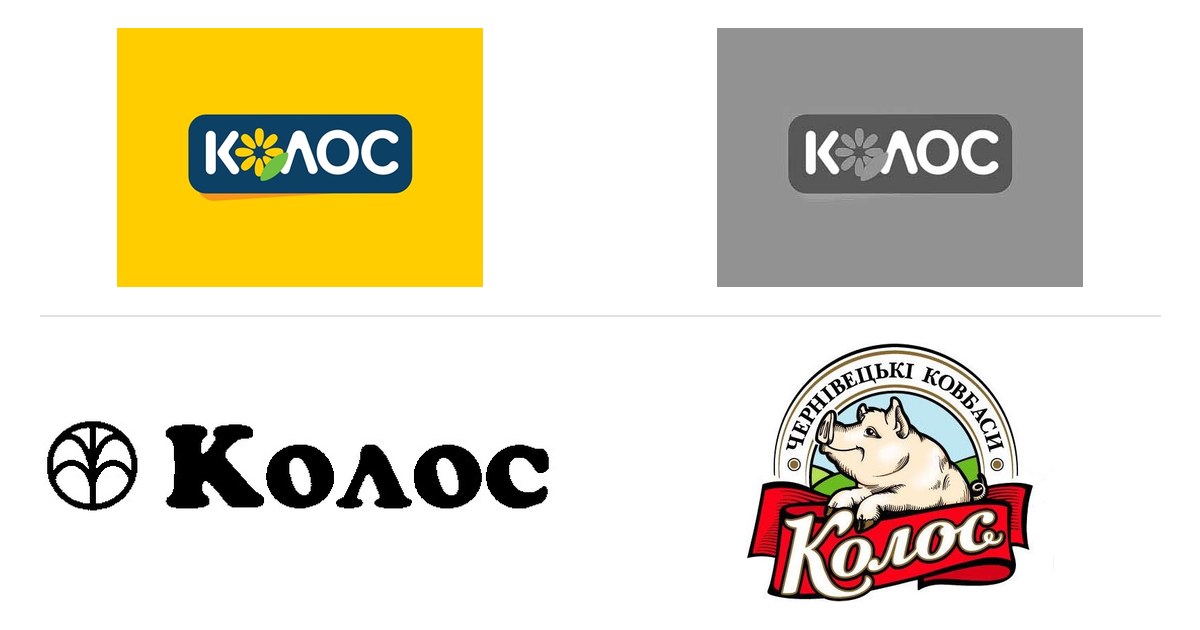
Top — applied-for signs
KOLOS (composite), applications No. m 2023 03402 (in colour) and No. m 2023 03403 (no colour claimed) of 10 March 2023
classes 29 and 35
Bottom — the appellant's marks
certificates No. 26444 and No. 113566
PE KOLOS, Chernivtsi
Images from the UANIPIO register
How the case reached the Appeals Chamber
On 4 July 2024 PE KOLOS filed oppositions against both applications under article 10(8) of the Law of Ukraine “On Protection of Rights to Marks for Goods and Services” (the Trademark Law). The applicant responded, and on 14 October 2024 UANIPIO decided to register both marks for all goods and services, accepting the applicant's arguments.
PE KOLOS appealed under article 15(1), paragraph two, of the Trademark Law. The main ground was article 6(3), paragraph two, of the Trademark Law: signs may not be registered if they are identical with or so similar as to be confused with, including by association,
“marks earlier registered or filed for registration in Ukraine in the name of another person for the same or related goods and services” (our translation).
The appellant also relied on article 6(2), paragraph six, of the Trademark Law: signs that “may mislead as to the person who produces the goods or provides the services”. The Board applied the Rules for filing and examining trademark applications.
The appellant's arguments
- it has used KOLOS for meat products since 1991, changing only the artwork, and filed its first trademark applications in 1999;
- the flower in the second position is read as the letter O, so the sign reads KOLOS. Evidence included Google, Instagram and Facebook material and photos from shops in Chernivtsi where the applicant's sausages are sold as KOLOS on labels and price tags;
- the goods are the same or related and are sold through the same channels to the same buyers, so consumers may think it is another PE KOLOS brand.
The applicant's arguments
- K.LOS is an independent sign with its own composition, supported by an analytical report on a consumer survey of January 2026, in which most respondents did not link it to other signs;
- “kolos” is a common Ukrainian word; many marks of different owners containing it coexist in classes 29, 30 and 35, and the appellant had not opposed them;
- the sign was created and put to use in good faith; the first supply contract was signed on 20 February 2023, before filing.
What the Board found
The appellant's later mark did not count. PE KOLOS also cited certificate No. 385253, but that application was filed on 11 November 2024, after the contested applications of 10 March 2023. Under article 5(6) of the Trademark Law the earlier filing date prevails, so the Board left this mark out of the comparison.
The flower is read as a letter. The dominant element of all the signs is the word KOLOS. The Board said that “despite the stylised first letter O in the applied-for sign, consumers perceive the word element as the word KOLOS” (our translation). The sound is identical, the meaning is the same, and the differences in colour and additional elements do not outweigh this. Conclusion: the signs are confusingly similar because they are associated as a whole (paragraph 15 of chapter 2 of section II of the Rules).
Related goods and services. The Board found the meat goods in class 29 identical or related to the appellant's goods, and the class 35 services connected with selling them related as well (paragraph 17 of chapter 2 of section II and paragraph 20 of chapter 8 of section VI of the Rules). The ground in article 6(3), paragraph two, of the Trademark Law therefore applied.
Similarity is not the same as misleading. The Board did not apply the ground of misleading as to the producer: there was no evidence that the sign is seen as pointing to PE KOLOS in particular, and similarity to the appellant's marks does not prove that by itself (paragraph 11 of chapter 2 of section II of the Rules).
The appellant set the limits. During the proceedings PE KOLOS amended its requests several times, and in its last request of 18 June 2026 asked for refusal only for part of the class 29 goods — meat products such as bacon, sausages, meat, canned meat, liver pâté, lard and ham. The appeal was upheld within those limits.
Our view
What follows is our assessment.
Artwork does not change the word. If a picture merely replaces a letter and the word is easy to read, the word is what gets compared. A “different visual identity” argument works when the perception of the whole sign changes, not just one letter.
The survey and the “common word” argument. How the Board assessed the applicant's survey report and the many third-party KOLOS marks, the decisions give no direct answer: the reasoning does not deal with that evidence separately and rests on the comparison with the appellant's marks.
The scope of refusal follows the request. The Board found class 35 services connected with selling meat goods related. But since the appellant's last request covered only part of the class 29 goods, class 35 stayed in the registration in full. What a party asks for defines what it gets.
Outcome
- the appeals of PE KOLOS were upheld in both cases;
- the UANIPIO decisions of 14 October 2024 to register the KOLOS composite marks under applications No. m 2023 03402 and No. m 2023 03403 were set aside;
- the marks are to be registered for a reduced list of class 29 goods (without the meat products named by the appellant) and for the class 35 services as filed. As of 20 November 2026 both applications are at the stage “preparation for state registration and publication” in the register;
- the decisions took effect on approval by orders, 6 November 2026, and may be challenged in court within two months of receipt (article 15(9) of the Trademark Law).
Takeaways for brand owners in Ukraine
Check how the name will be read, not only how it is spelled. Replacing a letter with a picture does not create a new word. Run a trademark search in Ukraine before launch, especially in the classes where an established competitor works.
File on time. PE KOLOS says it has used its new label since 2018 but filed for it only on 11 November 2024, and that mark did not count against the 2023 applications: the filing date decides (article 5(6) of the Trademark Law). Register a new logo before it reaches the market.
An opposition can still win after a decision to register. Examination did not agree with PE KOLOS; the Appeals Chamber did. If you have filed an opposition, UANIPIO's decision can still be appealed. Word your requests carefully: your request defines the scope of refusal. See trademark oppositions in Ukraine.
If your client's mark meets an earlier sign in Ukraine
We prepare oppositions and responses, gather evidence of use in Ukraine, and handle appeals before UANIPIO and the Appeals Chamber.
Send us the mark and the situation — we will tell you what we see. Or write to office@rivnepatent.ua.
Questions we are asked about this case
Does stylising a letter help avoid similarity with an earlier mark in Ukraine?
Not if the word is still read the same way. In the KOLOS case the first letter O was replaced by a flower, and the applicant argued that the sign reads as K.LOS. The Appeals Chamber held that consumers perceive and pronounce it as KOLOS and found it confusingly similar to the earlier marks for identical and related goods (article 6(3), paragraph two, of the Law of Ukraine “On Protection of Rights to Marks for Goods and Services”).
Is a mark filed later than the contested application taken into account?
No. The right to a certificate belongs to the applicant with the earlier filing date (article 5(6) of the Law of Ukraine “On Protection of Rights to Marks for Goods and Services”). The Board therefore disregarded the appellant's certificate No. 385253, filed on 11 November 2024, after the contested applications of 10 March 2023.
Does similarity of signs mean that consumers will be misled as to the producer?
Not necessarily. The Board said that similarity alone does not show that a sign points to a particular producer. There was no such evidence, so the ground of misleading as to the person who produces the goods or provides the services (article 6(2), paragraph six, of the Law of Ukraine “On Protection of Rights to Marks for Goods and Services”) was not applied.
Can the Appeals Chamber decisions in this case be challenged?
Yes. The applicant or the opponent may challenge an approved decision of the Appeals Chamber in court within two months of receipt (article 15(9) of the Law of Ukraine “On Protection of Rights to Marks for Goods and Services”). Both decisions were approved by orders of 6 November 2026.
Sources: decisions of the Appeals Chamber of UANIPIO of 15 July 2026 on application No. m 2023 03402, approved by Order No. 369/2026 of 6 November 2026 (full text, in Ukrainian), and on application No. m 2023 03403, approved by Order No. 372/2026 of 6 November 2026 (full text, in Ukrainian); UANIPIO register, applications No. m 2023 03402 and No. m 2023 03403 (as of 20 November 2026). Quotations are our translation. Provisions are cited from the Law of Ukraine “On Protection of Rights to Marks for Goods and Services” as in force from 26 February 2026, the Rules as in force from 18 September 2024 and the Regulation of the Appeals Chamber.
Decisions of the Appeals Chamber are public documents, published among other things so that the practice can be studied. This note analyses the reasoning of the decision — the arguments raised and how the Board assessed them — not the procedural history of the case. It contains no assessment of the conduct of the parties or their representatives. Rivnepatent did not represent either party. This material is for information only and is not legal advice.
 Author: Volodymyr Tarasiuk, Ukrainian patent and trademark attorney, Reg. No. 529
See also: PREMIERE GALON: Breitling fails to stop a Chanel watch mark in Ukraine · Trademark oppositions in Ukraine