A company that, by its own account, had imported and sold the medicine «Фенібут» (Phenibut) in Ukraine since 2012 wanted to register the name as a trademark. Sales worth hundreds of millions of hryvnias, a consumer survey and five of its own marks containing «Фенібут» did not help: the Appeal Chamber held the word to be a generic name of the medicine without distinctive character.
Decision of the Appeal Chamber of UANIPIO of 30 July 2026, approved by Order No. 342/2026 of 30 October 2026. The appeal of Rik-Farm LLC (ТОВ «Рік-Фарм») was rejected in full, and the decision of 5 November 2021 refusing registration of «Фенібут» under application No. m201824569 remains in force.
The parties and the marks
- Applicant: Rik-Farm LLC (UA); the application was filed on 19 October 2018 for the word sign «Фенібут» in standard characters for goods in Nice class 5;
- Specification after limitation: in the appeal the applicant limited it to «pharmaceutical preparations, namely: psychostimulant and nootropic agents»;
- Cited mark: the word mark «ФЕНІБУТ НЕКСТФАРМ», Ukrainian certificate No. 242057 of 25 May 2018, owned by Bioscience Ltd, United Kingdom.
The signs involved
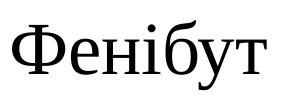
Applied-for sign
«Фенібут», application No. m201824569
goods in class 5

Cited mark
«ФЕНІБУТ НЕКСТФАРМ», certificate No. 242057
Bioscience Ltd (United Kingdom)
Images from the UANIPIO register
How the case reached the Appeal Chamber
During examination two patent attorneys filed reasoned third-party observations against the application (22 April 2019 and 19 June 2020), and the applicant answered them. On 7 December 2020 the examiner notified a possible refusal, and the applicant responded on 16 July 2021. The examiner's conclusion listed four grounds: the sign lacks distinctive character; it is commonly used for class 5 goods as a designation of goods of a certain kind; it may mislead as to goods of another kind; and for part of the goods it is similar to the mark «ФЕНІБУТ НЕКСТФАРМ». Registration was refused on 5 November 2021.
The applicant appealed to the Appeal Chamber: under article 15(1), paragraph one, of the Law of Ukraine “On Protection of Rights to Marks for Goods and Services” (the Law) an applicant may challenge a decision on an application in court or before the Appeal Chamber within two months of receiving it. The appeal was filed on 17 January 2022. Neither the appellant nor a representative of UANIPIO attended the hearing.
The applicant's arguments
- Imports and sales: the applicant imported the medicine «Фенібут» from 2012: 916,736 packs worth UAH 34.67 million in 2012–2019; 754,121 packs worth UAH 103.65 million were sold through wholesale distributors, and pharmacies sold 804,512 packs worth UAH 110.22 million to end consumers in 2012–2020;
- Marketing: the medicine may not be advertised (it is on the list of medicines banned from advertising), so the applicant invested in marketing and merchandising services: UAH 12.13 million in 2013–2019;
- Survey: by GLOBAL EXPERT UA LLC, 28 December 2020, 1,552 respondents (51% medical professionals, 49% consumers); 76% of respondents who knew the mark «ФЕНІБУТ» named the applicant as its owner;
- Marketing authorisation: in 2015–2020 the applicant held the Ukrainian marketing authorisation for «ФЕНІБУТ»; the manufacturer supported the registration in writing, and the new holder of the authorisation, Rocket-Farm LLC, does not object to it;
- Series of marks: the applicant owns five Ukrainian marks containing «Фенібут» for class 5 (certificates No. 175974–175977 of 25 September 2013 and No. 280881 of 10 August 2020), most of them filed and registered before «ФЕНІБУТ НЕКСТФАРМ».
What the Board established
The Board assessed the application under the law in force on its filing date, that is, before the amendments made by Law of Ukraine No. 815-IX of 21 July 2020, and applied the Rules approved by Order of the State Patent Office of Ukraine No. 116 of 28 July 1995 (the 1995 Rules; no longer in force). Under point 4.3.1.5 of those Rules, signs commonly used for goods of a certain kind are those that, «as a result of their long-term use for the same goods (services) or goods (services) of the same kind by different manufacturers, have become species or generic terms» (our translation).
To verify the examiner's conclusion, the Board consulted reference sources:
- Dictionaries: the Large Explanatory Dictionary of the Modern Ukrainian Language defines «Фенібут» as a medicinal preparation used for neurotic and psychopathic conditions; the medicine also appears in pharmacological dictionaries, reference books and textbooks;
- Ministry of Health documents: the Formulary Handbook on the use of medicines in neurology (Order of the Ministry of Health of Ukraine No. 11 of 14 January 2009) classifies «Фенібут (Phenibut)» among psychostimulant and nootropic agents;
- INN: according to the decision, Phenibut is included in the WHO Anatomical Therapeutic Chemical classification (code N06BX22) as the international non-proprietary name of the active substance; state registers of medicines list «Фенібут/Phenibut» in the INN field, including for generic products sold under other names;
- Pharmacies: «Фенібут» tablets and capsules from at least five different manufacturers are sold in hundreds of pharmacies.
The Board concluded that for psychostimulant and nootropic agents «ФЕНІБУТ» «has the character of a generic (commonly used) name of a pharmaceutical substance», its meaning is «clear and established for the relevant circle of consumers and professionals», and its use by different manufacturers «excludes the possibility of perceiving this sign as indicating exclusively one manufacturer» (our translation). The sign therefore cannot perform the basic function of a trademark — distinguishing the goods of one manufacturer from similar goods of others.
INN: not an independent ground, but an additional argument
The Board referred to WHO resolution WHA46.19, the WHO guidance on the use of INNs and the EUIPO Guidelines, under which INNs are not registered as trademarks. At the same time it stated expressly that the fact that a sign is an INN «is not considered an independent ground for refusal of legal protection, but is taken into account together with other established circumstances as an additional argument confirming that the sign is commonly used and lacks distinctive character» (our translation).
Deceptiveness, similarity and the series of marks
- Deceptiveness: not examined, because after the limitation the goods for which the examiner saw a risk of misleading were no longer part of the application;
- Similarity to «ФЕНІБУТ НЕКСТФАРМ»: not assessed separately, as the absolute grounds for refusal were sufficient;
- Series of marks: rejected. A series of one owner's marks is built on a strong element, whereas «ФЕНІБУТ» is «a weak (unprotectable) element in any trademark» (our translation). The existing marks containing «фенібут» owned by different persons, including the appellant itself, were treated as evidence of «long-term, good-faith and parallel use» of the word by different businesses.
The decision does not analyse the sales, marketing and survey evidence separately: it only states that all materials were assessed together according to the Board's inner conviction.
Our view: the name of a substance belongs to everyone
What follows is our assessment; the decision does not put it this way.
The current Law of Ukraine “On Protection of Rights to Marks for Goods and Services” does not protect commonly used signs either: under article 6(2), paragraph three, of the Law, protection is refused to signs that «consist only of designations that are commonly used in modern language or in bona fide and established trade practice in respect of goods and services». The current Rules approved by Order of the Ministry of Economy of Ukraine No. 19889 of 6 August 2024 (the Rules; point 4 of chapter 2 of section II) give as an example of a commonly used sign «a general, common or traditional name of goods (services)» (our translation). Neither the Law nor the Rules contain a specific provision on INNs, but judging by the Fenibut decision, this changes little for the name of an active substance.
The most telling part of the case is what happened to the evidence of use. Sales of a hundred million hryvnias and a survey might persuade if the word were merely descriptive or weak. But for a name used equally by doctors, reference books and other manufacturers, use by one seller does not make it «its own». And the applicant's own series of «Фенібут» marks turned against it: it showed that the word was already used by different owners.
The generics with their own names mentioned in the decision show a workable path: a fanciful brand name does the distinguishing, while the INN simply identifies the active substance.
Outcome
- the appeal of Rik-Farm LLC was rejected in full;
- the decision of 5 November 2021 refusing registration of «Фенібут» under application No. m201824569 remains in force;
- the decision took effect on approval by order, 30 October 2026, and may be challenged in court within two months of receipt.
Takeaways for pharmaceutical brands in Ukraine
The name of an active substance is not a brand. Build the trademark for a medicine on a fanciful word and keep the INN as a descriptive element. Search before filing — trademark search in Ukraine.
Use does not save a generic word. The Appeal Chamber took a similar approach to a descriptive name in the «СМЕТАНА ДО БОРЩУ» case.
A series of marks must rest on a strong element. If the common word in a series is generic, it gives no exclusive rights and will not help against competitors.
Third-party observations work. Here, patent attorneys filed reasoned observations during examination. See trademark oppositions in Ukraine.
If your client is choosing a name for a medicine in Ukraine
We search the Ukrainian register, assess whether a proposed name risks being treated as generic or descriptive, and file and defend applications before UANIPIO and the Appeal Chamber.
Send us the name and the goods — we will tell you what we see on the register. Or write to office@rivnepatent.ua.
Questions we are asked about this case
Can the name of a medicine that coincides with the name of its active substance be registered as a trademark in Ukraine?
In the Fenibut case, no. The Board of the Appeal Chamber held that «Фенібут» (Phenibut) for psychostimulant and nootropic agents «has the character of a generic (commonly used) name of a pharmaceutical substance» and therefore lacks distinctive character. Different manufacturers use it freely, so it does not point to any one of them.
Is an international non-proprietary name (INN) a separate ground for refusal in Ukraine?
Neither the Law of Ukraine “On Protection of Rights to Marks for Goods and Services” nor the Rules approved by Order of the Ministry of Economy of Ukraine No. 19889 of 6 August 2024 mentions INNs as such. In the Fenibut decision the Board stated expressly that the fact that a sign is an INN «is not considered an independent ground for refusal», but is taken into account as an additional argument confirming that the sign is generic and lacks distinctive character (our translation).
Can large sales and a consumer survey prove distinctiveness of a generic name?
Not in this case. The applicant showed sales since 2012 of over UAH 100 million and a survey in which 76% of respondents aware of the mark named it as the owner. The Board still concluded that the sign is generic and lacks distinctive character; the decision contains no separate analysis of the survey.
Does a series of the applicant's own marks with a generic word protect that word?
Not in this case. The Board called «ФЕНІБУТ» a weak (unprotectable) element in any trademark and held that no one can hold exclusive rights to this word. Moreover, the existing marks containing it owned by different persons, including the applicant itself, were treated as evidence of parallel use of the word by different businesses.
Source: decision of the Appeal Chamber of UANIPIO of 30 July 2026 on the appeal of Rik-Farm LLC (ТОВ «Рік-Фарм», UA) against the decision of 5 November 2021 refusing registration of the trademark «Фенібут» under application No. m201824569, approved by Order No. 342/2026 of 30 October 2026. Full text of the decision (in Ukrainian). UANIPIO register: application m201824569, certificate No. 242057. Quotations are our translation. Provisions are cited from the Law of Ukraine “On Protection of Rights to Marks for Goods and Services” as in force from 26 February 2026, the 1995 Rules applied by the Board, and the current Rules as in force from 18 September 2024.
Decisions of the Appeal Chamber are public documents, published among other things so that the practice can be studied. This note analyses the reasoning of the decision — the arguments raised and how the Board assessed them — not the procedural history of the case. It contains no assessment of the conduct of the parties or their representatives. Rivnepatent did not represent either party. This material is for information only and is not legal advice.
 Author: Volodymyr Tarasiuk, Ukrainian patent and trademark attorney, Reg. No. 529
See also: СМЕТАНА ДО БОРЩУ: use did not save a descriptive name · tochka v ТОЧКА: owning the website did not secure the trademark