A case from our practice
A Polish company sent a Ukrainian furniture maker a demand letter: one of its products allegedly infringed a registered EU design and had to be removed from every EU sales channel within seven days. We checked the register and the history of the design itself and replied within the deadline. A week later the company withdrew the claim in full, in writing.
The case in brief
- Client: a Ukrainian furniture maker selling in the EU through online marketplaces;
- Claim: 23 September 2026 — remove the product from EU sales within seven days, based on an EU design filed in 2021;
- Our response: 28 September 2026, on day five of seven;
- Outcome: on 5 October 2026 the company withdrew all its claims in writing and confirmed it would not pursue them; the product stayed on sale.
Where we started
The obvious move in such a situation is to compare your product with the images in the register and argue about similarity. We did it the other way round: first we checked whether the design had any force and whether the sender was entitled to use it.
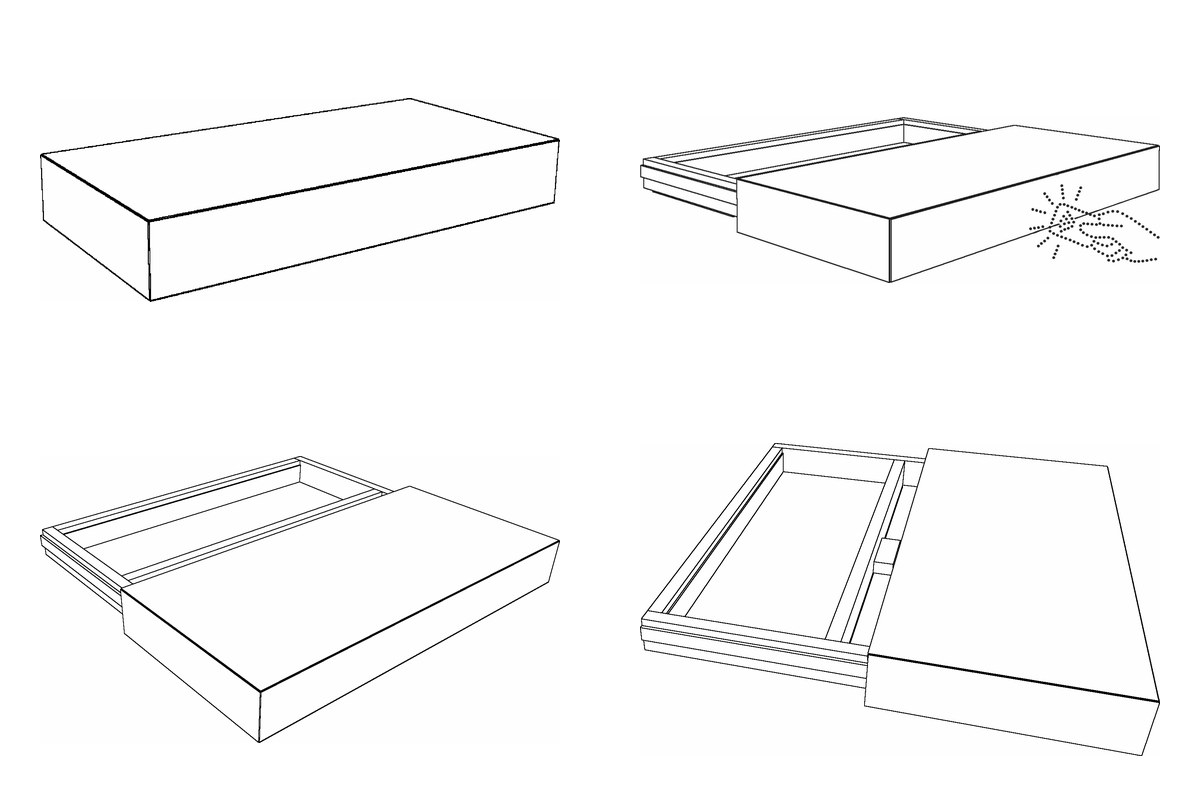
The EU design relied on in the claim
four of the seven registered views: closed, unlocking, body slid forward, hidden compartment open
Images from the EUIPO register
The reason is simple. EU designs are registered without examination of novelty or individual character: the EUIPO checks formal requirements, and the substance is assessed only if someone applies for a declaration of invalidity. A registration certificate on its own does not mean the design will survive scrutiny.
Who actually holds the design
According to the EUIPO register, the holder was a different person — a Polish furniture maker. The company that sent the claim did not appear in the register as holder, licensee or representative. In fact, it had itself been incorporated almost four months after the design was filed.
The applicable law is Regulation (EU) 2026/715 of the European Parliament and of the Council of 11 March 2026 on European Union designs (codification) (the Regulation), which replaced Council Regulation (EC) No 6/2002 on 1 July 2026. Under Article 36(3) of the Regulation, a licensee may bring infringement proceedings only with the holder's consent, unless the licence contract provides otherwise; an exclusive licensee may act alone only if the holder, having been given notice, does not bring proceedings within an appropriate period. The claim showed neither a licence nor the holder's consent.
The holder showed the product five years before filing
Next we traced the history of the product shown in the design. It turned out that the holder had been selling it long before filing:
- an Internet Archive capture of the product page in the holder's online shop, dated 4 August 2016, offers the product for sale with prices and sizes, with customer reviews from January and March 2016 below it. The page says it is the shop's own design;
- an archived copy of the same shop's home page of 5 January 2018 names the holder's business as the producer;
- on 18 March 2018 the shop's channel published a YouTube video showing the same product, with the same appearance and mechanism. A business card of the holder's business stands on it throughout.
Timeline
| Jan–Mar 2016 | customer reviews on the product page in the holder's shop |
| 4 Aug 2016 | Internet Archive capture of the product page |
| 18 Mar 2018 | video of the product on the shop's YouTube channel |
| 31 Jul 2020 | start of the 12-month grace period |
| 31 Jul 2021 | EU design filed and registered |
| 23 Sep 2026 | claim sent to our client |
| 28 Sep 2026 | our response |
| 5 Oct 2026 | written withdrawal of the claim |
Why this is decisive. Under Article 8(2) of the Regulation, a disclosure by the designer or a successor in title is disregarded only if it took place during the 12 months preceding the filing date. The design was filed on 31 July 2021, so the grace period began on 31 July 2020. The 2016 and 2018 disclosures fall outside it by years. They form part of the prior art and deprive the design of novelty (Article 6 of the Regulation) and individual character (Article 7 of the Regulation). Such a design may be declared invalid under Article 27(1)(b) of the Regulation.
The exception for disclosures that could not reasonably have become known to the specialised circles in the EU did not apply: this was a Polish online shop and a public video.
Our response
We replied in English on behalf of the client, on two arguments, each of which works on its own.
First: the sender has no standing. It is not in the register and showed no licence or consent from the holder. Without such a document the demand has no legal basis.
Second: the design is invalid. We enclosed the archived shop pages, frames from the video side by side with the registered views, a timeline and a certified copy of the registration certificate from the EUIPO.
We deliberately did not argue about how similar the client's product was to the registered design. If the design is invalid, there is nothing to compare with, and a debate about details would only have given the other side something to answer.
We also spelled out the consequences. If the claim was not withdrawn, or a complaint was filed with a marketplace, the client would immediately apply to the EUIPO for a declaration of invalidity. Any person may rely on this ground (Article 27(2)(a) of the Regulation), and a declaration of invalidity takes effect from the outset: the design is deemed never to have had effect (Article 28(1) of the Regulation). We also warned about liability for unjustified marketplace complaints.
Within seven days — the same period the sender had given the client — we asked for a written withdrawal of the claim, confirmation that no marketplace complaints had been or would be filed, and, if the sender maintained it had any right in the design, the document on which it relied.
Outcome
- on 5 October 2026, exactly a week later, the company withdrew all its claims in writing and confirmed it would not pursue them;
- the client's product stayed on sale throughout;
- no application to the EUIPO was needed, so the client spent nothing on the fee and invalidity proceedings.
Our view: why it worked
The withdrawal letter gives no reasons, so what follows is our assessment.
Above all, the evidence came from the holder itself: its shop, its customer reviews, its video with its own business card in the frame. That is hard to dispute. Second, the response left no room for bargaining: two independent arguments, all evidence already enclosed, a clear deadline and a clear next step. Third, we gave no opening for a debate on similarity, where the other side would still have had something to say.
Practical points
Do not take the product down in a panic, but do not stay silent. The deadline in a demand letter is the sender's, not the law's. Marketplaces, however, act on complaints quickly, so answer within the same period.
Check who is writing. The holder may enforce the design; a licensee only with the holder's consent or under an exclusive licence. The EUIPO register is public, and it is the first thing to check.
Dates matter more than similarity. Archived web pages, videos, social media posts, catalogues and trade fairs show when the public first saw a product. If that happened more than 12 months before filing, the registration is vulnerable, even where the holder itself made the disclosure.
An invalidity application is a tool, not an obligation. Sometimes it is enough to show that the evidence is ready and the next step is set. Whether to file at once or respond first depends on the case, the strength of the evidence and the other side's conduct.
File your own designs in time. The grace period works for you too: once you start selling a product, file the EU design application within 12 months of the first disclosure. Later, your own disclosure becomes an argument against your registration.
Questions and answers
Should a seller take a product down as soon as an EU design claim arrives?
No. The deadline in a demand letter is the sender's requirement, not the law's. First check who holds the design, whether the sender is entitled to enforce it, and whether the design was new on its filing date. Do not ignore the claim either: marketplaces act on complaints quickly, so it is better to answer within the deadline.
Can a holder rely on a design it disclosed itself before filing?
Only if the disclosure took place within the 12 months before the filing date. That is the grace period under Article 8(2) of Regulation (EU) 2026/715 of the European Parliament and of the Council of 11 March 2026 on European Union designs (codification). An earlier disclosure, even by the holder itself, destroys novelty and individual character, and the registration can be declared invalid.
Who can enforce an EU design: the holder or a licensee?
The holder. Under Article 36(3) of Regulation (EU) 2026/715 of the European Parliament and of the Council of 11 March 2026 on European Union designs (codification), a licensee may bring infringement proceedings only with the holder's consent, unless the licence contract provides otherwise. An exclusive licensee may act on its own only if the holder, having been given notice, does not bring proceedings within an appropriate period.
Is it always necessary to file an application for a declaration of invalidity?
Not always. Here a response with the evidence already gathered and clearly stated consequences was enough: the claim was withdrawn and no application to the EUIPO was needed. Whether to file at once or to respond first is decided case by case.
If your client sells in the EU or in Ukraine
We handle demand letters and disputes over designs and trademarks for Ukrainian businesses selling in the EU, and file EU and Ukrainian design and trademark applications. More on how we work with IP firms.
Send us the demand letter — we will tell you how strong it is. Or write to office@rivnepatent.ua.
Source: case file — the claim of 23 September 2026, our response of 28 September 2026 and the withdrawal letter of 5 October 2026. The provisions cited are those of Regulation (EU) 2026/715 of the European Parliament and of the Council of 11 March 2026 on European Union designs (codification), in force since 1 July 2026.
Rivnepatent represented the client in this matter. At the client's request we do not give its name, brand or products; we also do not name the party that sent the claim or give the design number. This material is for information only and is not legal advice.
 Author: Volodymyr Tarasiuk, Ukrainian patent and trademark attorney, Reg. No. 529
See also: HRV: a monogram the examiner read as «RV» · NAUMCHUK: a surname objection overcome